· 9 min read
What Is Kakanin? An Australian Guide to Filipino Rice Cakes
What is kakanin? Discover Filipino rice cakes, their regional variety, ingredients, textures and what Australian shoppers should know.
What is kakanin? The short answer
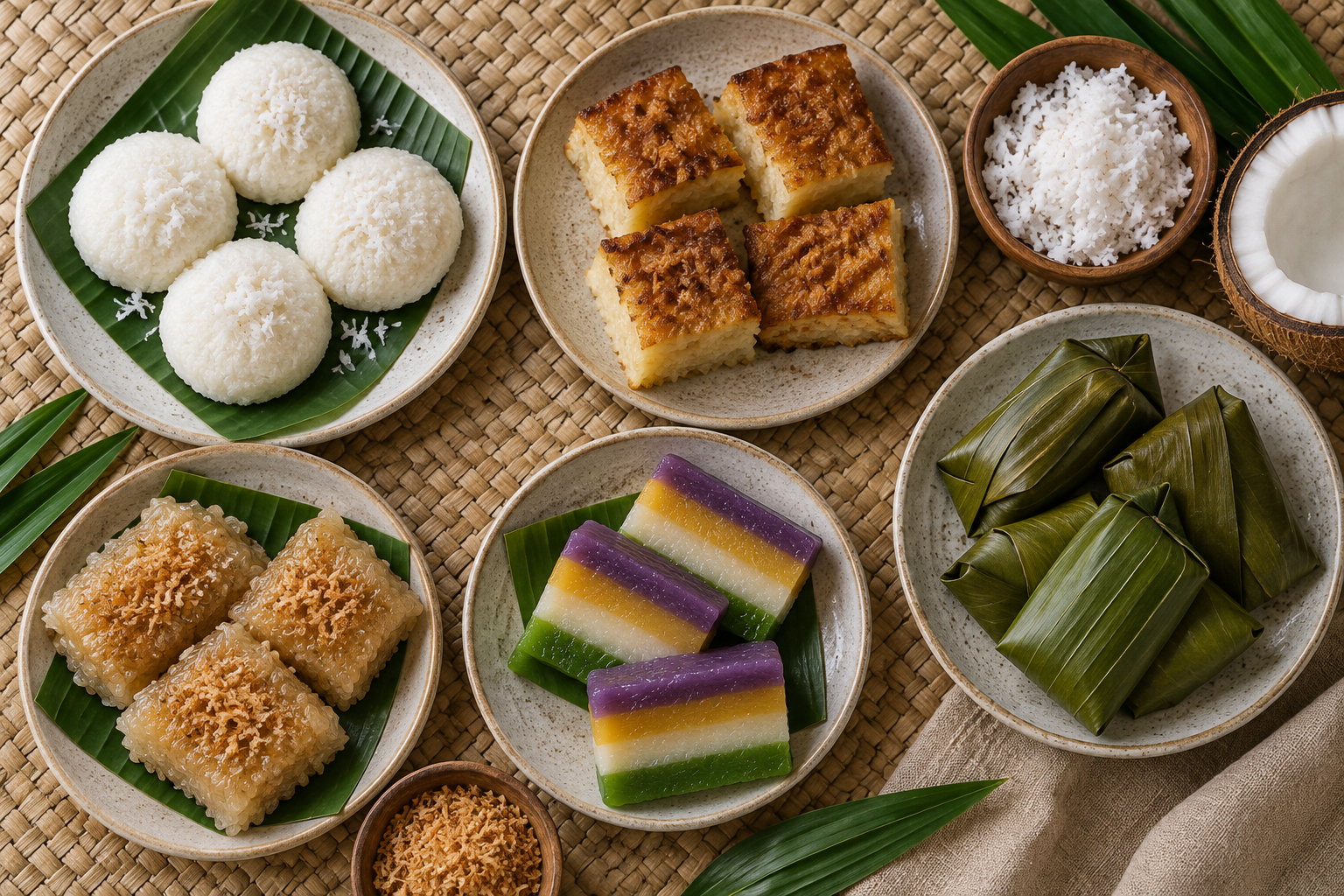
Kakanin is a broad Filipino category of rice-based delicacies. Many are made with glutinous rice, ground rice or rice flour, often combined with coconut milk and sugar, then steamed, baked, grilled or cooked until sticky. The category includes soft steamed cakes, dense coconut-rice slices, layered sweets and leaf-wrapped parcels. It is more accurate to think of kakanin as a large family of foods than as one recipe or one texture.
PhilRice’s kaKanin+ project documents and maps rice-based foods across the Philippines using field surveys, interviews and records of traditional processing. Its catalogue is valuable because it shows how strongly these foods vary by region. Australians meeting kakanin for the first time should therefore expect many names, forms and family versions—not a single national cake that every Filipino makes in exactly the same way.
Learn why rice matters in Filipino culture →Start with the beginner’s guide to Filipino food →
Kakanin is a category, not a single dessert
Calling every kakanin a ‘rice cake’ is useful shorthand in English, but it can hide the range. Some pieces are airy and steamed; others are chewy, compact or pudding-like. Some are baked until the surface browns, while others are cooked in leaves or bamboo. Many are sweet, yet the sweetness and serving role vary. A piece may appear at breakfast, merienda, a market stall, a family gathering or a seasonal celebration.
The name also does not guarantee one ingredient list. Traditional forms may begin with soaked and ground rice, whole glutinous rice or a particular local variety. Modern versions can use packaged rice flour, wheat flour, colouring, cheese, eggs or dairy. Even foods sharing the same familiar name can differ between towns and households. Ask what the item actually contains and how its maker describes it instead of treating an online definition as a universal rule.
Why regional variety matters
The Philippines is an archipelago, so ingredients, languages, cooking equipment and local crops have shaped many distinct rice delicacies. PhilRice created kaKanin+ specifically to inventory, map and study rice-based food products from different regions. The project combines food science with cultural and local knowledge, a reminder that a delicacy is connected not only to its recipe but also to place, livelihood and the people who continue making it.
The National Museum gives a precise example from Ilocos Sur: tinubong is a kakanin made with sticky rice and grated coconut, enriched with coconut milk and cooked inside bamboo over a kiln or charcoal. It is similar to tupig found in Ilocos Norte and Pangasinan, but the Museum still identifies its particular provincial context and method. That is a better model for learning than collapsing every regional food into one generic rice cake.
How rice creates different textures
Whole glutinous rice produces a recognisably sticky, cohesive bite when cooked with liquid. Ground rice or rice flour can form batters that set into soft, springy or firm cakes depending on moisture, fermentation, fat and cooking method. Coconut milk adds richness and can help create a tender or glossy result. Sugar affects flavour and texture, while toppings such as grated coconut or toasted coconut add contrast.
Glutinous rice is named for its sticky cooked texture; the word does not mean that rice naturally contains gluten. That distinction is useful, but it does not make every finished kakanin gluten-free. A particular recipe may contain wheat flour, toppings, flavourings or ingredients processed with gluten. The only safe conclusion comes from the complete recipe, product label and cross-contact information supplied by the maker.
Steamed, baked, sticky and layered styles
Puto commonly refers to steamed cakes, while bibingka commonly describes baked or grilled rice-cake styles. Suman is associated with rice mixtures enclosed in leaves, and biko is usually a dense, sticky combination of glutinous rice, coconut milk and sugar. Kutsinta has a chewy texture, while sapin-sapin is known for visible layers. These descriptions help a newcomer choose, but each name still covers variations rather than one fixed formula.
Texture is often the easiest way to explore the category. If you prefer a lighter bite, begin with a plain steamed piece. If you enjoy caramelised edges and coconut richness, try a baked or sticky style. Layered kakanin can combine colours and flavours, while leaf-wrapped forms bring aroma and a satisfying parcel-like presentation. Buy a small mixed selection when available and compare it at room temperature or as the maker recommends.
Why leaves and bamboo matter
Banana, coconut, buri and other plant leaves are functional cooking materials, not merely decoration. The National Museum explains that their structure, flexibility and aroma make them useful for wrapping food. It documents suman varieties cooked in banana leaves and suman sa ibos held in woven palm strips. The wrapper can shape the parcel, hold the mixture during cooking, protect it for transport and add a subtle fragrance.
Traditional wrapping also carries knowledge: how to soften a leaf, fold it without leaking, weave a container and match the wrapper to the food. The Museum describes traditionally wrapped food as tangible cultural heritage reflecting regional cuisines. That does not mean every modern kakanin must use leaves. Paper, moulds and other equipment may be practical in Australian kitchens, but an original wrapper can be an important part of the item’s method and identity.
Read about pandan’s fragrance and uses →See the National Museum source on traditional wrapping →
Is kakanin always sweet?
Many familiar examples are sweetened, but the level of sweetness ranges from mild to rich. Coconut, rice, caramelised sugar and toppings may be as important as sweetness itself. Some steamed cakes can accompany savoury food, and regional delicacies do not all fit neatly into the Australian idea of dessert. It is safer to ask whether a particular item is sweet, savoury or intended as an accompaniment than to decide from the word kakanin alone.
Flavours can include coconut, toasted rice, brown or muscovado-style sugar, pandan and ube, but their use varies. Bright colour is not proof of a particular ingredient: it may come from a flavouring, colouring or a combination. When buying a prepared item, read the label or ask the maker instead of inferring ube, pandan or natural colour from appearance. The flavour should be described by the product, not guessed from a photograph.
When Filipinos eat kakanin
Kakanin can be everyday food and celebration food. It may be bought from a market or specialist seller, shared at merienda, brought to a gathering or prepared for a religious and community occasion. Particular forms can be strongly associated with a town, season or household. The most respectful explanation uses that specific context rather than claiming that all Filipinos eat the same cake at the same event.
Food also carries memory. The smell of warmed banana leaf, the pull of sticky rice or the topping used by one relative can identify a version more powerfully than its English translation. For Filipino Australians, buying or making kakanin may preserve that connection while adapting to local ingredients and equipment. For newcomers, asking who made it and where their version comes from opens a better conversation than searching for one official ranking.
Explore Filipino fiesta traditions →Read about Filipino homecoming gifts →
Buying kakanin in Australia
Fresh kakanin may be sold by Filipino bakeries, groceries, market vendors or home-based food businesses, while packaged mixes and frozen products can offer another route. Availability changes, especially for fresh items with short shelf lives. In Bunbury, contact Hernandez Asian Delights for current stock or guidance rather than assuming a particular cake is always available. Ask whether an item should be eaten fresh, warmed, refrigerated or frozen.
Use the product’s exact name when possible and look beyond colour. Check the ingredient list, date marking, storage instructions, pack integrity and allergen statement. For unpackaged food, ask the seller directly. If you are buying for a party, confirm the quantity, collection time, serving method and safe holding plan in advance. A delicate steamed cake and a dense sticky tray may respond very differently to refrigeration and reheating.
Use the Filipino grocery guide for Bunbury →Visit Hernandez Asian Delights →
Allergens and dietary questions
Kakanin is not automatically vegan, dairy-free, egg-free or gluten-free. Coconut milk is common in many versions, but dairy milk, cheese, butter, eggs or wheat may appear in others. Toppings and fillings can introduce peanuts, tree nuts, sesame or soy, while shared preparation areas create cross-contact risk. Rice as the main ingredient cannot answer a dietary question about the finished food.
FSANZ requires prescribed allergens to be declared using required names on packaged foods sold in Australia. For food that does not need a label, allergen information must be displayed with the food or provided on request. Anyone with a diagnosed allergy or coeliac disease should ask about the exact item, ingredients and cross-contact controls. Do not rely on a broad category name, visual inspection or another seller’s recipe.
Storage and rice-food safety
Moist rice cakes can be perishable, particularly when they contain coconut milk, dairy, egg or fresh toppings. Follow the maker’s storage directions and use-by date. Do not assume that sugar, wrapping or a firm texture makes an item shelf-stable. If instructions say to refrigerate, keep it at 5°C or colder and return it promptly after serving. Discard food left outside safe time and temperature controls rather than judging only by smell.
FSANZ identifies pre-cooked starchy foods such as rice as higher-risk foods for Bacillus cereus when handled poorly. Its current guidance is to serve cooked food immediately or keep it at 60°C or hotter, and to cool food for later use quickly in smaller containers before refrigerating. Spores and some toxins may survive cooking, so reheating does not repair unsafe storage. For a purchased product, the seller’s validated instructions take priority over general internet advice.
How to taste and serve kakanin respectfully
Begin with the name supplied by the maker, then notice texture, rice flavour, coconut, sweetness, browning and the aroma of any leaf wrapper. Remove non-edible ties or outer materials and ask whether the leaf is a wrapper, liner or intended part of the serving. Try the cake at the recommended temperature before changing it. Some pieces are best soft and warm; others become easier to cut after setting.
For a shared table, label each variety and provide separate utensils. Cut rich or sticky trays into modest portions so guests can compare more than one style. Kakanin can sit naturally beside savoury Filipino dishes, drinks or other merienda foods without being presented as an exotic challenge. If planning a Bunbury event, discuss the current dessert and catering options directly with Hernandez and build the selection around the real guests, storage and service time.
Explore Hernandez catering options →Request catering for your event →See Hernandez pork crackle for a savoury contrast →
Frequently asked questions
What does kakanin mean in English?
‘Filipino rice cakes’ or ‘rice-based delicacies’ is the most useful short translation. Kakanin describes a broad category rather than one cake, so the individual name—such as puto, suman, biko or bibingka—usually tells you more about the food.
What is kakanin made from?
Many versions use glutinous rice, ground rice or rice flour with coconut milk and sugar. Ingredients vary widely, and some modern recipes include wheat flour, egg, dairy, cheese, flavourings or colouring. Check the recipe or label for the exact product.
Is all kakanin gluten-free?
No. Rice is naturally gluten-free, but a finished kakanin may contain wheat or other gluten ingredients, or be exposed through shared equipment. People with coeliac disease or allergy should verify the complete ingredient and cross-contact information with the maker.
Is kakanin a dessert or a snack?
It can be either, and some forms can accompany savoury food. Kakanin appears at breakfast, merienda, markets, family gatherings and celebrations. The intended role depends on the particular delicacy, region and household rather than one national rule.
Where can I buy kakanin in Bunbury?
Filipino and Asian food businesses may offer fresh, frozen or packaged rice delicacies, but stock changes. Contact Hernandez Asian Delights for current availability and storage advice. If ordering for an event, confirm quantity, collection or delivery, allergens and serving time in advance.
Keep exploring Filipino food and culture
Taste it in Bunbury
Bring Filipino flavour to your next gathering.
Explore catering from Hernandez Asian Delights or visit Michael and the team at 36 Charles Street, Bunbury.