· 9 min read
Why Is Rice Important in Filipino Culture?
Why is rice important in Filipino culture? Explore its place in everyday meals, language, farming, celebrations and Filipino food in Australia.
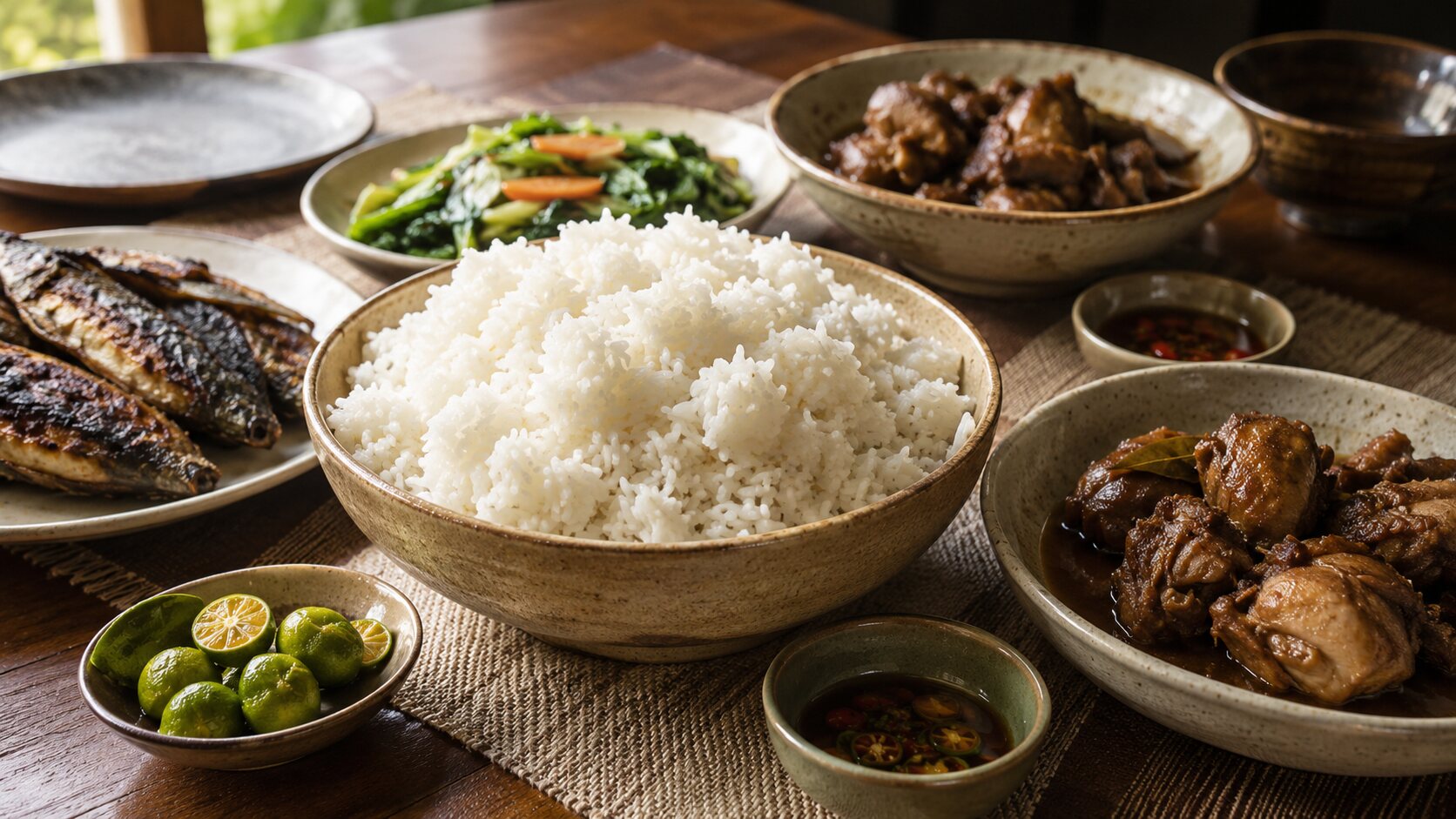
Why is rice important in Filipino culture? The short answer
Rice is important in Filipino culture because it is an everyday staple, the centre of many meals, a source of farming livelihoods and a material used in regional rituals, celebrations and foods. The National Museum of the Philippines says rice goes beyond its role as a staple: in several ethnolinguistic communities it is embedded in daily routines, rituals and festivities. That significance is practical, social and cultural rather than one simple national tradition.
At an ordinary meal, plain rice often balances salty, sour, rich or strongly seasoned ulam—the dish eaten with rice. At breakfast, leftover rice may become garlic-fried sinangag. Rice can also become porridge, noodles, flour, sweets, drinks or leaf-wrapped kakanin. These forms make it present from quick home meals to carefully prepared celebrations, although what people eat varies by region, household, income, health needs and personal preference.
Not every Filipino eats white rice at every meal. Corn and root crops also matter in particular regions and periods. Rice provides a widely shared culinary language, but its uses remain diverse.
Rice is central, but the history is not a simple straight line
Rice has a long history in the Philippine archipelago, but ‘Filipinos have always eaten rice exactly as they do today’ would be an inaccurate claim. The International Rice Research Institute’s Rice Today reports archaeological evidence of carbonised rice in pottery from the Cagayan Valley dating to around 3400 BCE. That is evidence of an ancient crop presence, not proof that rice was the universal daily staple for every community at that time.
PhilRice’s historical material explains that rice became more widely established as a staple through changes in farming technology, trade and colonial economies. Its account notes that root crops, millet, corn and sweet potato also occupied important places in diets. Geography matters: irrigated lowlands, mountain terraces, dry areas and islands offered different growing conditions. Farmers developed or adopted varieties suited to particular environments rather than working with one national grain.
Rice may organise many meals, yet local crops and regional knowledge still shape what accompanies or replaces it. Recognising both centrality and variation avoids presenting the Philippines as one unchanging rice culture.
The language of rice follows it from field to plate
Filipino languages distinguish rice at different stages. A Philippine Information Agency feature explains that palay refers to unhusked rice, bigas to milled uncooked rice and kanin to cooked rice. Bahaw describes cooked rice left from an earlier meal, while sinangag is fried rice, commonly with garlic. The exact vocabulary differs across languages and regions, but the distinctions show how closely people observe the grain’s journey.
These words carry practical knowledge. A farmer handles palay differently from a shopper buying bigas. A cook does not treat freshly steamed kanin like cooled bahaw intended for another dish. When Australians hear a breakfast name ending in ‘silog’, the ending combines sinangag and itlog, or egg. Tapsilog, for example, typically brings together tapa, garlic rice and egg; other prefixes signal other accompaniments.
These terms do not prove identical family habits. They name recurring activities—growing, milling, cooking, saving and transforming rice—and make a Filipino menu easier to understand.
How rice shapes a Filipino meal
In many Filipino meals, rice is not an afterthought placed beside a self-contained main. It works with the ulam. A spoonful of adobo sauce, a salty piece of grilled fish, a sour sinigang broth or a rich vegetable stew is experienced in relation to plain rice. The rice softens intensity, carries sauce and gives diners control over the balance of each mouthful.
This helps explain why a dish can taste too salty or sharp when sampled alone. It may have been seasoned to accompany rice. The relationship does not mean cooks should ignore balance or serve unlimited quantities; it means the intended eating context matters. When introducing Filipino food to Australian guests, serve enough rice and explain which dishes are designed to be eaten with it rather than judging each component in isolation.
Rice also supports sharing when a central pot accompanies dishes placed for the table. At a kamayan meal, rice and viands may be arranged on banana leaves and eaten with the hands, but kamayan is a particular style of eating, not every Filipino meal.
Learn what a kamayan feast means →See how rice balances Filipino chicken adobo →
Rice appears in many forms, not only as a plain side
Different forms require different grains. Jasmine or another long-grain rice may suit steamed rice and sinangag, while glutinous rice is used for many sticky sweets. Brown, red and black rice retain different layers and characteristics. Follow a tested recipe rather than assuming every packet labelled rice will behave the same way.
Steamed rice and garlic fried rice
Fresh steamed rice is the familiar everyday foundation. Sinangag turns cooked rice into a fragrant breakfast dish with garlic and oil. SBS Food describes it as a Filipino favourite often served with meat or egg. It is commonly associated with day-old rice, but leftovers must have been cooled and stored safely before frying.
Lugaw, arroz caldo and goto
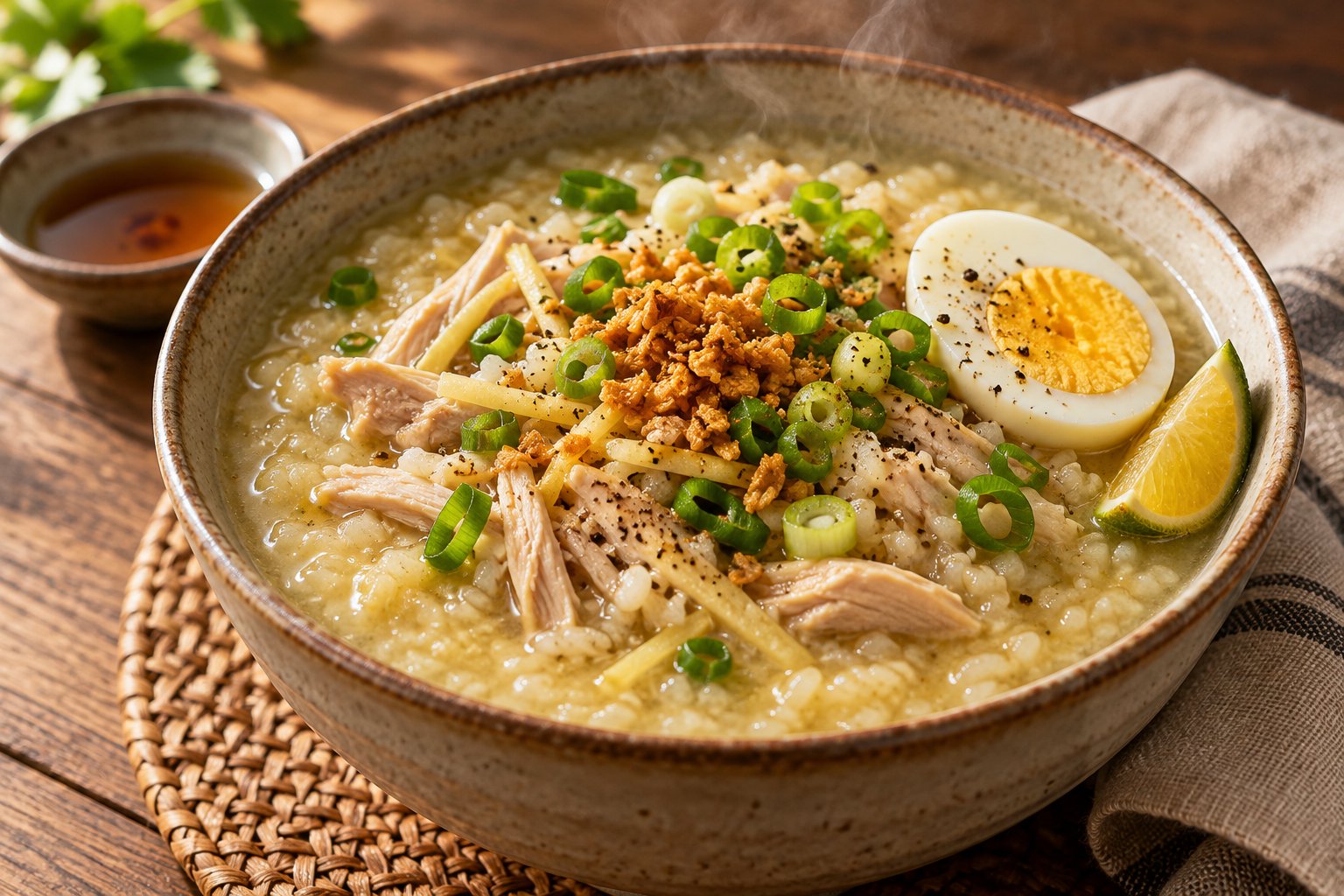
Rice becomes comfort food when cooked into porridge. Names and recipes vary, but lugaw can refer to a basic rice porridge, arroz caldo commonly includes chicken and ginger, and goto is associated with offal in many versions. These are related dishes rather than rigid definitions that erase family or regional usage.
Champorado
Champorado is a chocolate rice porridge served at breakfast or as a snack. Filipino versions may use tablea cacao and can be paired with salty dried fish, creating a sweet-savoury contrast that surprises some Australians. The pairing has cultural context; it is not a novelty invented for social media.
Kakanin and leaf-wrapped rice foods
Kakanin is a broad category of rice-based delicacies rather than one recipe. The National Museum documents regional examples such as tinubong from Ilocos Sur, made with sticky rice and coconut milk in bamboo, while suman itself has many forms. Ingredients, wrapping, texture and occasion depend on place and maker.
Rice carries specific regional and spiritual meanings
The strongest examples of rice as cultural heritage belong to particular communities and should be described specifically. The National Museum explains that bulul or bulol are carved ancestral and guardian figures connected with Ifugao rice culture in the Cordillera. Once consecrated through appropriate community ritual, they are associated with protecting stored grain and supporting abundance. They are not generic Filipino decorations.
The museum’s rice gallery brings together material culture associated with planting, harvesting, processing and storing rice, alongside traditional knowledge and modern science. Mortars, pestles, rice cutters, granaries and ritual objects show that a bowl of cooked rice represents labour and systems extending far beyond the kitchen. The meanings differ across ethnolinguistic groups; one community’s sacred object should never be used to stand in for all Filipinos.
Rice also appears in remembrance and offerings. The National Museum’s account of Ilocano atang during Undas lists sticky-rice foods and uncooked rice among possible offerings, while noting related practices by other groups. That documented example should not be converted into a claim that every Filipino family observes the same ritual. Cultural accuracy begins with naming the community and occasion.
Farming, food security and respect for every grain
Rice connects consumers with farmers, irrigation, weather, seed selection, milling, transport and public policy. PhilRice develops varieties for different ecosystems, including irrigated, rainfed, drought-, flood- and saline-prone areas. Its 2025 anniversary report said more than 100 varieties developed through its work were planted across major Philippine rice ecosystems. That diversity responds to real environmental and food-security pressures.
Respect for rice often includes avoiding waste. National rice-awareness campaigns in the Philippines encourage responsible portions and better use of leftovers. The principle is practical rather than romantic: grain represents land, water, labour and household money. Cook an amount your table can eat, or plan safely for what remains.
Australians can show respect by buying a suitable quantity, cooking it carefully and avoiding waste. If served a regional heirloom rice, ask about its origin; aroma, colour and texture may be part of what its growers preserve.
Choosing and cooking rice in an Australian kitchen
For everyday Filipino meals, jasmine rice is an approachable starting point, but the recipe should decide the grain. Glutinous rice is not simply ‘extra sticky’ ordinary rice; its starch behaviour makes it suited to particular sweets and snacks. Brown and pigmented rice need their own water and cooking times. Check the packet, rinse only when the directions or recipe call for it, and measure consistently so you can adjust next time.
A rice cooker is convenient but not culturally compulsory. A saucepan works when you use an appropriate rice-to-water ratio, controlled heat and a resting period. Different rice, cookware and stove settings change the result, so there is no universal cup ratio that covers every product. Keep the packet until you know how that rice behaves.
When shopping locally, start with the dish you plan to make. Hernandez Asian Delights is at 36 Charles Street, Bunbury, but this article does not promise stock. Phone 08 9768 0755 before travelling for a specific rice variety, brand or package size. The recent pantry guide explains how to compare labels and choose a focused first basket.
Use the Filipino grocery guide for Bunbury →Plan a visit to the Hernandez store →
Cooked rice safety matters
Cooked rice can cause food poisoning when it is cooled or stored incorrectly. HealthyWA explains that uncooked rice may contain Bacillus cereus spores that survive cooking. If cooked rice spends too long between 5°C and 60°C, bacteria can grow and produce toxin. Unsafe rice may look, smell and taste normal, and reheating does not reliably undo toxins already produced.
Serve rice promptly or keep it at 60°C or hotter. If saving it, cool it quickly and refrigerate it below 5°C. HealthyWA recommends dividing rice into clean, shallow containers so it cools faster. FSANZ advises putting cooked food in the fridge or freezer as soon as it stops steaming and using refrigerated leftovers within three to four days, or within one day for vulnerable people.
Sinangag can use rice handled correctly. If storage history is uncertain or the rice spent too long warm, discard it rather than relying on smell or a hot fry-up.
Experiencing Filipino rice culture in Bunbury
The most useful way to understand rice in Filipino culture is to eat it in context. Try plain rice with adobo and notice how the sauce changes. Taste garlic rice as part of breakfast, porridge as comfort food or a rice cake as a regional delicacy. Ask the name of the dish, who made it and whether the recipe carries a family or regional story.
For a catered event, rice choice affects the whole menu. Plain rice can support bold mains; noodles may add another shared element; specialty rice dishes can change preparation time, service and dietary considerations. Contact Hernandez Asian Delights with your guest count, venue, preferred dishes and dietary needs so Michael can confirm current options rather than relying on a general article.
Michael’s pork crackle can also be served alongside a broader Filipino spread when confirmed with the store. The best call to action is simple: visit the Bunbury shop, ask informed questions and let rice do what it has long done at Filipino tables—bring dishes and people together.
Explore Filipino catering packages →Request a tailored catering quote →Discover Hernandez pork crackle →
Frequently asked questions
Do Filipinos eat rice at every meal?
Rice accompanies many Filipino meals and may appear at breakfast, lunch or dinner, but not every Filipino eats it at every meal. Household preference, region, health needs, income and the food being served all matter. Corn, root crops, bread and noodles also have important places in Philippine diets.
What is cooked rice called in Filipino?
Kanin is a common Filipino term for cooked rice. Palay refers to unhusked rice and bigas to milled uncooked rice. Bahaw can mean cooked rice left from an earlier meal, while sinangag is fried rice. Other Philippine languages have their own terms.
What rice is best for Filipino food?
There is no single best rice for every Filipino dish. Jasmine rice is a practical everyday choice for many savoury meals, glutinous rice is used in numerous rice cakes and sweets, and brown or pigmented varieties have different textures and cooking needs. Follow the specific recipe and packet directions.
Why is garlic fried rice common at Filipino breakfast?
Sinangag makes cooked rice into a fragrant breakfast component with garlic and oil and is often served with egg and a savoury accompaniment. It can use safely cooled leftover rice, turning an existing staple into a different meal while reducing waste.
How should leftover rice be stored safely?
Keep cooked rice at 60°C or hotter if serving it hot, or cool it quickly in shallow containers and refrigerate below 5°C. Do not judge safety by smell or appearance. Follow HealthyWA and FSANZ guidance, and discard rice when its storage history is uncertain.
Keep exploring Filipino food and culture
Taste it in Bunbury
Bring Filipino flavour to your next gathering.
Explore catering from Hernandez Asian Delights or visit Michael and the team at 36 Charles Street, Bunbury.