· 9 min read
What Is Ube? An Australian Guide to Filipino Purple Yam
What is ube? Learn what Filipino purple yam is, how it differs from taro and purple sweet potato, how it is used, and what to check when buying it in Australia.
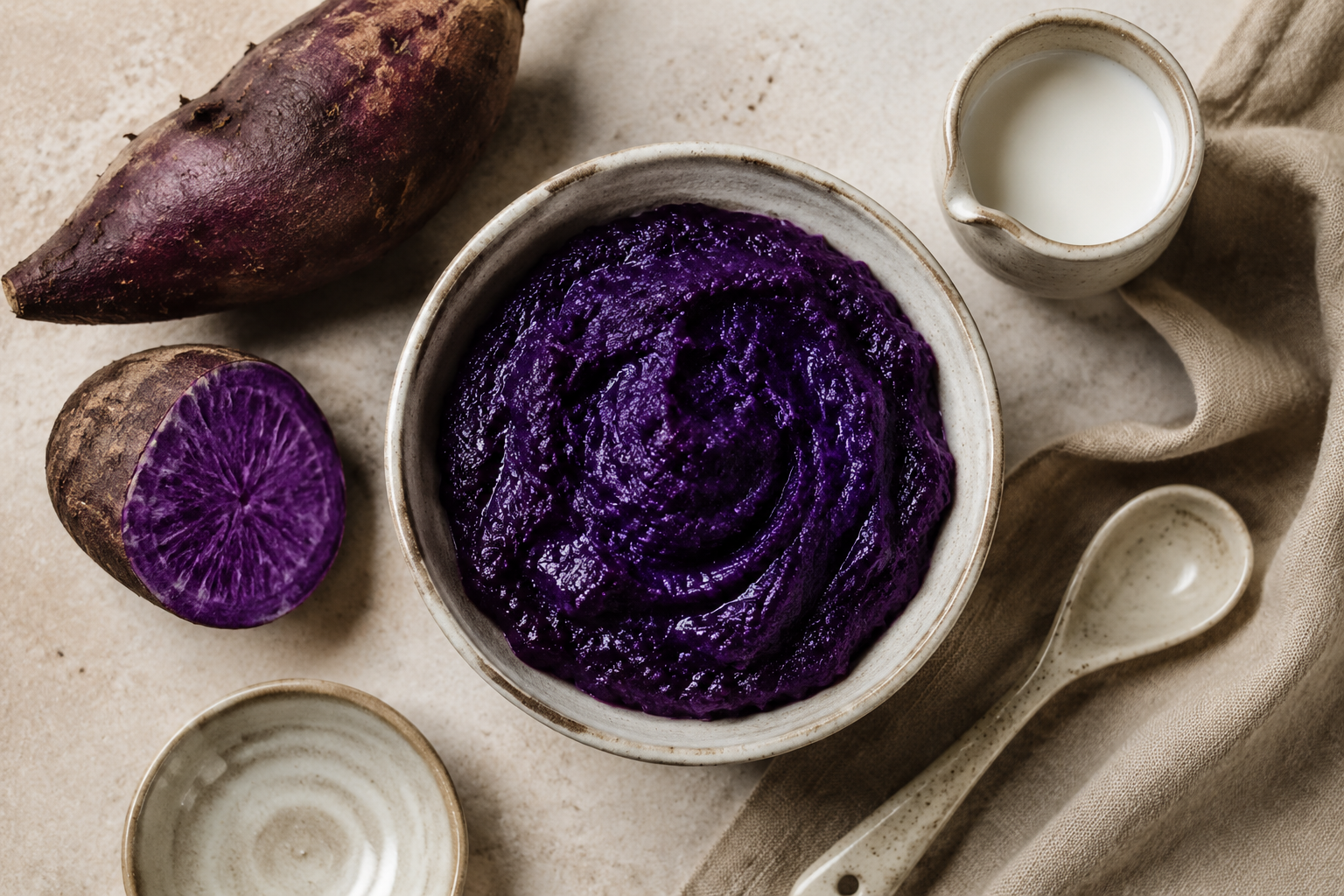
What is ube? The short answer
Ube is the Filipino name commonly used for purple yam, usually Dioscorea alata. It is a true yam: the edible underground tuber of a climbing plant in the Dioscorea family. Royal Botanic Gardens, Kew accepts Dioscorea alata as a distinct species native across tropical Asia, including the Philippines, and records its use as food. In Filipino cooking, ube is best known in sweet preparations such as ube halaya, cakes, breads, ice cream and halo-halo.
The ingredient itself and the flavour sold as ‘ube’ are not always the same thing. Fresh or frozen purple yam, ube powder, bottled jam, paste, extract and ready-made desserts can contain very different amounts of actual yam. Sugar, milk, coconut products, flavouring and colour may be added depending on the product and recipe. Read the ingredient list instead of using colour alone as proof of what is inside.
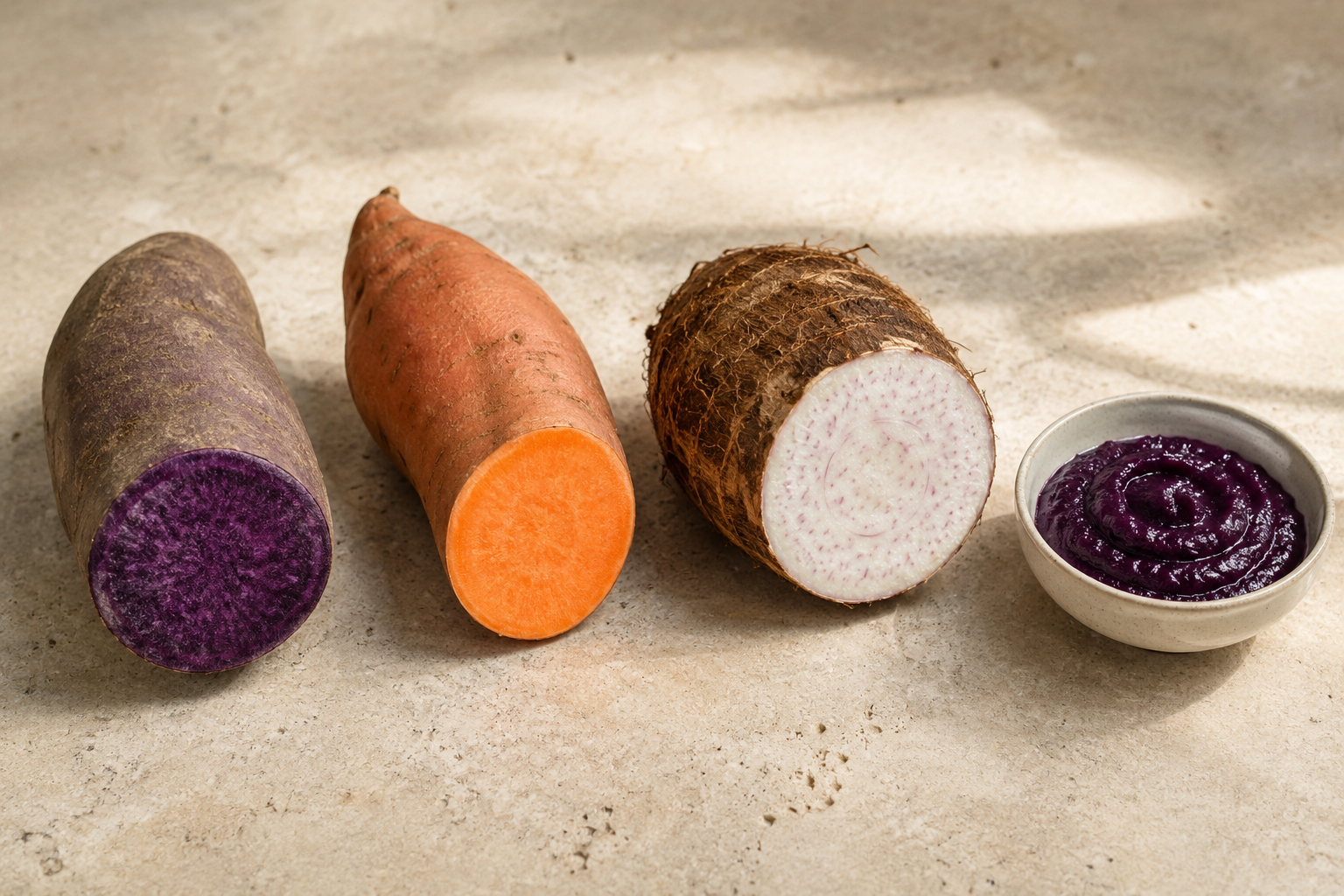
Ube is also not another name for taro or purple sweet potato. Those are different plants with different textures and culinary histories. They can all appear purple in photographs or finished desserts, which is why Australians frequently confuse them. The botanical name and ingredient list provide a better answer than the shade of purple.
Read the beginner’s guide to Filipino food →Plan a visit to the Hernandez store →
Why ube matters in Filipino food
Ube is not simply a recent social-media colour trend. The Philippine Department of Agriculture’s Agricultural Training Institute describes purple yam as a sought-after crop used from halo-halo to ube jam and in desserts and pastries. Government agricultural programs train growers in planting material, crop management, post-harvest handling and value-adding because demand depends on a reliable supply of real tubers, not only on flavouring.
The crop has particular importance in Bohol, where the spelling ubi is widely used. The Philippine Council for Agriculture, Aquatic and Natural Resources Research and Development identifies Ubi Kinampay as a culturally and economically important Bohol variety, valued for aroma, colour and taste. It also documents other named varieties and research intended to improve planting material and extend production. One famous variety should not be treated as the only authentic ube; Philippine purple yams are diverse.
That agricultural context matters. When ube appears in a bun, cheesecake or latte in Australia, the finished item sits at the end of a chain involving growers, varieties, processors and exporters. Calling every purple dessert ‘ube’ can hide that chain. A more useful question is whether the product uses purple yam, an ube preparation such as halaya or powder, flavouring, colouring, or a combination.
What does ube taste like?
People often describe cooked ube as gently sweet, earthy and nutty, with a soft vanilla-like aroma in some varieties and preparations. That description is a guide, not a fixed tasting note. The variety, maturity, cooking method and added ingredients all change the result. A plain cooked tuber will not taste as sweet, creamy or perfumed as commercial ube ice cream or a jar of halaya.
Texture changes too. Properly cooked yam can be starchy and dense, while ube halaya is worked into a thick, smooth paste. Milk, condensed milk, coconut milk, butter or sugar can provide much of the richness people associate with an ube dessert. Extracts may amplify aroma, and colouring may deepen or standardise the purple. None of these choices automatically makes a product good or bad, but they make label reading essential when you want to know what you are tasting.
If you are trying ube for the first time, compare two forms rather than chasing the brightest dessert. Taste a small amount of halaya, then try it in a bread, cake or cold dessert. Notice the yam flavour beneath the dairy, coconut and sugar. Ask the maker what form of ube was used; responsible sellers should be able to explain the major ingredients and allergen information.
Ube, taro and purple sweet potato are different
The difference is more than botanical trivia. It affects cooking time, texture, safe preparation and whether a recipe behaves as expected. Do not use an unidentified raw tuber on the assumption that all purple roots are interchangeable. Buy food from a reputable retailer, keep the packaging and follow reliable product or recipe directions.
Ube versus taro
Ube is generally Dioscorea alata, a yam. Taro is Colocasia esculenta, a different plant in the arum family. Taro flesh is commonly white or cream with purple flecks, although varieties differ; cooked taro is often used in savoury dishes as well as sweets. Purple colour in bubble tea does not prove that a drink contains ube, and an ube-labelled drink should not be assumed to contain taro.
Ube versus purple sweet potato
Purple sweet potatoes belong to Ipomoea batatas, the same species as other sweet potatoes, not the yam genus Dioscorea. Their colour and sweetness make them useful in desserts, but substituting one for ube changes moisture, starch, flavour and colour. A recipe written for purple sweet potato may still be enjoyable, yet it should be named accurately rather than presented as ube.
Why the names become confusing
Common names move between countries, shops and languages. ‘Yam’ is also used loosely for some sweet potatoes in overseas marketing. Finished products may use a blend or an ube-style flavour profile. In Australia, look for the words purple yam or Dioscorea alata when identifying the ingredient, then check the complete label because the front of the package is only a starting point.
How Filipinos use ube
Ube halaya is one of the most recognisable preparations. The Philippine Agricultural Training Institute publishes a version that cooks purple yam with sugar, coconut milk, condensed milk and butter until it forms a thick paste. Recipes differ by household and region: some emphasise dairy, others coconut, and sweetness and texture vary. Halaya may be eaten as a sweet in its own right or used as a component in other desserts.
Halo-halo can include a spoonful of ube or ube ice cream among shaved ice, milk and assorted components. Bakers use ube in pandesal-style rolls, ensaymada, cakes, cheesecakes, biscuits and pastries. It may also appear in ice cream, puddings and modern drinks. These are different applications, not evidence that one standard paste works perfectly in every recipe.
For home cooking, choose the form the recipe specifies. Fresh or frozen yam needs cooking and preparation. Powder needs rehydration according to the product or recipe. Halaya already contains moisture and often sugar and fat, so dropping it into a cake formula can change the crumb. Extract adds aroma but does not replace the bulk, starch or texture supplied by actual yam.
See how Filipino sweets fit into a shared feast →Explore the guide to Filipino fiestas →
Which form of ube should you buy in Australia?
Fresh ube can be difficult to find consistently, and this article does not claim that any Bunbury retailer has it today. Frozen grated purple yam can be practical for halaya when a trusted recipe calls for it. Powder stores more easily but brands vary in concentration, added ingredients and rehydration directions. Halaya is convenient for spreading or layering but is already a formulated sweet product, not plain yam.
Ube extract is useful when a recipe has been designed for it, particularly for aroma or colour, but a small bottle should not be treated as nutritionally or functionally equivalent to a tuber. Ube-flavoured mixes may contain sugar, starch, dairy ingredients or colours. Compare the ingredient list, allergen statement, country of origin, storage directions and use-by or best-before information.
At Hernandez Asian Delights, ask the team which ube forms are currently available and what each one is intended for. Stock, brands and pack sizes can change, so phone 08 9768 0755 before travelling for a particular item. Bring the recipe or a photo of its ingredient list; ‘ube for baking’ is less precise than asking for frozen grated yam, halaya, powder or extract.
Use the Filipino grocery guide for Bunbury →Find Hernandez Asian Delights in Bunbury →
Read the label before serving an ube product
Purple yam itself does not tell you whether a finished dessert suits a dietary requirement. Halaya, ice cream, cake, bread and flavoured drinks may contain milk, egg, wheat, soy, nuts or other ingredients depending on the recipe and production environment. A purple colour does not mean a product is dairy-free, vegan or gluten-free.
Food Standards Australia New Zealand requires specified allergens to be declared when present in packaged foods, using required names in the ingredient list and a separate ‘contains’ summary statement. For unpackaged food, allergen information must be displayed with the food or available from the supplier. Precautionary statements such as ‘may contain’ address possible unintended presence and should also be taken seriously by people managing allergies.
Ask about the exact product on the day rather than relying on a general article or a previous purchase. For catering, give the business written details of allergies and dietary requirements early enough to confirm ingredients and cross-contact controls. Hernandez can discuss current menu options, but only a confirmed order and product-specific information should guide an allergy decision.
Plan a Filipino catering menu in Bunbury →Request catering information →
Do not bring fresh ube into Australia without checking
Travellers and importers should not assume a fresh tuber, planting material or homemade product can enter Australia because it is ordinary food elsewhere. The Australian Department of Agriculture, Fisheries and Forestry says plant-based foods must meet biosecurity import conditions designed to prevent pests and diseases. Conditions depend on the commodity, country of export, processing and intended use.
Use the Australian Government’s BICON system before packing or ordering a product from overseas. If a commodity or country pathway is not listed, it may not be permitted until conditions are developed. Commercial imports must also meet Australian food safety and labelling requirements. Processed powder, jam, frozen yam and fresh tubers can fall under different conditions; one approval does not establish a rule for every ube product.
For an Australian home cook, the simplest low-risk approach is to buy a legally imported, clearly labelled food product from a reputable local retailer. Keep it stored as directed. This supports traceability and removes the temptation to guess at border rules or at the identity of an unlabelled tuber.
A simple way to explore ube in Bunbury
Begin with a product where the flavour can still be recognised. A modest spoonful of halaya, an ube-filled bread or a straightforward ube dessert can be more informative than a heavily decorated novelty. Check whether purple yam appears in the ingredient list, note any dairy or coconut ingredients, and compare sweetness and texture without expecting every maker to produce the same result.
Then place ube within a broader Filipino food experience. Pair dessert with a savoury shared meal, learn why rice balances strongly seasoned dishes, or ask how sweets appear at a fiesta or family gathering. Ube is a useful doorway into Filipino food, but it should not reduce a diverse cuisine to one fashionable colour.
Visit Hernandez Asian Delights at 36 Charles Street, Bunbury, to ask about current groceries and prepared food, or discuss a Filipino catering menu for your event. Pork crackle may also suit a wider shared spread when confirmed with the store. The strongest buying question is not ‘What is the most purple thing?’ It is ‘Which product contains the ube form that suits what I want to make or serve?’
Explore Filipino catering packages →Request a tailored catering quote →Discover Hernandez pork crackle →
Frequently asked questions
Is ube the same as purple sweet potato?
No. Ube is usually Dioscorea alata, a true yam in the Dioscorea genus. Purple sweet potato is Ipomoea batatas. Both can have purple flesh and appear in desserts, but their texture, moisture and flavour differ, so use the ingredient named by the recipe.
Is ube the same as taro?
No. Taro is Colocasia esculenta and ube is generally Dioscorea alata. Taro is a different plant and commonly has pale flesh with coloured flecks, although varieties differ. Product names and labels are more reliable than the colour of a finished drink or dessert.
What is ube halaya?
Ube halaya is a thick Filipino purple yam preparation often made by cooking ube with sugar and dairy or coconut ingredients. Recipes vary between families and regions. Because many versions contain milk or other allergens, check the exact recipe or package rather than assuming suitability.
Where can I buy ube in Bunbury?
Hernandez Asian Delights is at 36 Charles Street, Bunbury WA 6230. Availability, brands and pack sizes can change, so phone 08 9768 0755 before travelling if you need fresh or frozen purple yam, powder, halaya or extract.
Can I substitute ube extract for purple yam?
Not as a direct substitution. Extract can provide aroma or colour but does not provide the moisture, starch, bulk or texture of cooked yam. Follow a recipe written for the exact form you have and account for sugar and liquid already present in halaya or other prepared products.
Keep exploring Filipino food and culture
Taste it in Bunbury
Bring Filipino flavour to your next gathering.
Explore catering from Hernandez Asian Delights or visit Michael and the team at 36 Charles Street, Bunbury.