· 9 min read
What Is a Barong Tagalog? An Australian Guide
What is a Barong Tagalog? Learn its history, fabrics, embroidery, formal use and how Australians can wear and buy one respectfully.
What is a Barong Tagalog? The short answer
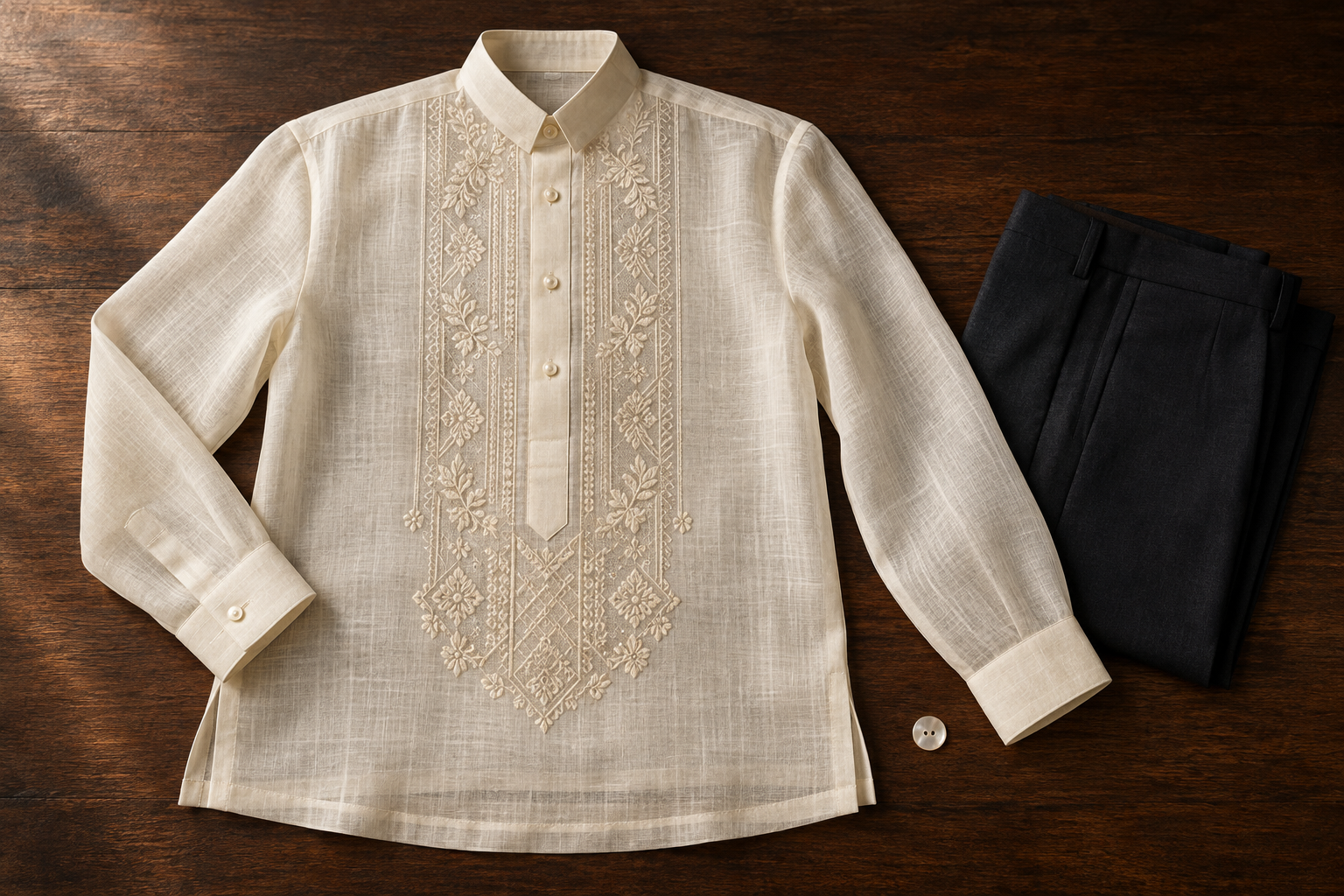
A Barong Tagalog is a lightweight, embroidered formal shirt associated with the Philippines. The Philippine Department of Foreign Affairs describes the traditional Barong Tagalog as the national costume for men and says it is suitable for formal occasions in the same way as a suit and tie. Its familiar modern form has long sleeves, a small collar, a partly buttoned front and embroidery concentrated on the chest, although cut, colour, fabric and decoration vary.
It is clothing, not a costume prop. Filipinos wear barongs at weddings, graduations, official ceremonies, diplomatic occasions, cultural celebrations and other important gatherings. For an Australian invited to a Filipino event, the practical answer is simple: check the invitation or ask the host. If a barong is welcome, choose a well-made garment, wear it neatly and treat its cultural meaning with the same care you would give any formal dress tradition.
Read our guide to Filipino fiestas →Explore Filipino wedding catering in Bunbury →
What does a Barong Tagalog look like?
There is no single design that covers every period, region or maker. The Cultural Center of the Philippines, summarising a 2025 lecture by cultural scholar Dr Nicanor Tiongson, describes the recognisable late nineteenth-century form as a shirt made from piña or jusi, with a half-open buttoned front, small collar, long loose sleeves and buttoned cuffs. Decoration often runs down the front panel. Tiongson calls the concentrated chest embroidery the pechera.
Many formal barongs are pale and somewhat translucent, allowing the structure and embroidery to be seen clearly. Others use stronger colours, opaque cloth, shorter cuts or contemporary tailoring. Embroidery may be restrained and geometric or far more elaborate. The all-over openwork style known as callado became prominent in the twentieth century, according to the CCP account. These differences do not automatically make one version more authentic than another; they show a living garment shaped by makers, wearers and occasions.
The word barong is widely used as a convenient short form, while official and cultural sources also use Barong Tagalog and Barong Filipino. When buying, focus on the actual garment rather than relying on a broad product name. Ask about its fibre, construction, embroidery, sizing and maker so that you understand what you are paying for.
A history with gaps, not one simple origin story
Popular retellings sometimes offer a neat colonial explanation for every feature of the barong: why it is sheer, why it is embroidered or why it is worn over trousers. The evidence is more complicated. The CCP expressly notes that a scientific history of the garment still needs to be written. That warning matters. A responsible introduction should distinguish documented changes from stories repeated without firm evidence.
Tiongson’s historical outline begins with precolonial garments including the badu, a mid-thigh shirt, and the bahag. Dress changed during Christianisation and Hispanisation, and the baro continued to evolve. By the nineteenth century, members of the emerging Filipino elite wore versions of the shirt in portraits and photographs. Western-style collars and cuffs appeared, while embroidery became more concentrated on the chest. By the end of that century, the shape was close to what many people now recognise as the formal barong.
The history is best understood as adaptation rather than a costume preserved unchanged from one founding moment. Indigenous dress, colonial rule, tailoring, local fibres and later national politics all contributed.
Learn why Philippine Independence Day is on 12 June →Discover the meaning of bayanihan →
How the barong became a symbol of public identity
The barong’s modern public status developed through repeated use by political leaders as well as by ordinary families. The CCP traces deliberate national symbolism to Commonwealth president Manuel Quezon, whose baro carried Commonwealth emblems. It records Ramon Magsaysay wearing a barong for his presidential swearing-in and credits him as the first president to do so. Carlos P. Garcia continued the practice, while Diosdado Macapagal wore one at his 1961 inauguration and promoted the garment as national formal dress.
Later presidents and public figures kept it visible at ceremonies. The CCP says Ferdinand Marcos popularised a shorter, waist-length form for formal functions; succeeding presidents continued wearing barongs in different forms. These choices helped move the garment beyond a regional or antiquarian image and into the visual language of Philippine state occasions and modern Filipino identity.
The Lawphil legal archive also records Proclamation No. 1374, approved on 17 January 1975, which declared 5–11 May 1975 Barong Filipino Week—government promotion of an already established garment.
Piña, jusi and other barong fabrics
Piña is the most celebrated fibre associated with fine barongs. It is produced from pineapple leaves and woven into a delicate cloth. In 2023, UNESCO inscribed Aklan piña handloom weaving on the Representative List of the Intangible Cultural Heritage of Humanity. The recognised element is the knowledge and practice of piña weaving in Aklan—not the Barong Tagalog as an object. That distinction honours the weavers without mislabelling the garment itself as UNESCO listed.
The CCP historical account also names jusi alongside piña in nineteenth-century barongs. Contemporary sellers may use piña, jusi, abaca, silk, polyester or blends, and product language is not always consistent across markets. A fabric name alone does not tell you whether fibres were grown, spun, woven, embroidered or assembled in the Philippines. Ask the maker or retailer for a fibre-content label and a plain explanation of origin and production.
Philippine law gives useful context. Republic Act No. 9242, the Philippine Tropical Fabrics Law approved in 2004, defines Philippine tropical fabrics through natural fibres produced, spun, woven or knitted and finished in the Philippines, and directs their use in government uniforms and procurement. The law promotes local textile production; it does not declare that every barong is made from those fibres or that every imported shirt meets that definition.
When is a Barong Tagalog worn?
A barong can be appropriate wherever Philippine formal dress is requested or welcomed: weddings, milestone birthdays, graduations, diplomatic receptions, national-day celebrations, church occasions and community events. The level of formality varies. A highly embroidered long-sleeved barong may suit a formal wedding, while a simpler design may suit a daytime gathering. The invitation, venue, hosts and local custom are better guides than a universal chart.
For weddings in Australia, look for wording such as Filipino formal, Barong Tagalog, Filipiniana or cultural attire. If the dress code only says formal or cocktail and you are unsure, ask the couple or organiser. Do not assume that every Filipino wedding requires national dress, and do not pressure Filipino guests to wear it. Families have different preferences and may combine Philippine and Australian conventions.
A traditional formal barong is commonly styled over an undershirt and formal trousers and is often designed to be worn untucked. Cuts differ, however, especially in contemporary fashion. Follow the maker’s instructions and look at how the hem, side openings and length are designed. A garment tailored to be tucked in should not be treated as identical to a classic long formal barong.
Plan Filipino catering for a Bunbury celebration →Use our Filipino catering menu-planning guide →
Can non-Filipinos wear a Barong Tagalog?
Yes, in many settings a non-Filipino guest can wear a barong respectfully, especially when a Filipino host has invited or encouraged cultural dress. Respect comes from context and conduct, not ancestry alone. Choose a real garment rather than a novelty imitation, learn what it is, dress to the requested level of formality and let the occasion—not the wearer’s performance—remain the focus.
Avoid presenting yourself as an authority on Filipino identity because you bought one shirt. Do not add invented insignia, military-style decorations or sacred-looking symbols whose meaning you do not understand. If a design uses regional motifs or a maker identifies a specific community tradition, ask about it. Buying from a Filipino designer, tailor, cooperative or transparent retailer is one practical way to support the people who sustain the craft.
Language matters too. Describe it as Filipino formal attire or a Barong Tagalog, not as an exotic costume. Compliments can recognise the maker, fibre or embroidery without reducing the garment to a photo prop. These small choices make cultural participation feel like hospitality accepted with care.
How to choose a barong in Australia
Start with the event. A wedding party may specify a colour or designer, while a guest may have more freedom. Confirm whether the occasion is daytime or evening, indoors or outdoors, and how formal the rest of the clothing will be. If ordering from overseas, leave time for measuring, delivery, alteration and a careful try-on; never rely on the size label alone.
Request garment measurements for shoulders, chest, sleeve, collar, body length and upper arm, then compare them with a well-fitting shirt. Ask whether the fit is traditional and relaxed or contemporary and close. Because some fabrics are translucent, check whether an undershirt is included or recommended. Photographs should show the fabric and embroidery close up as well as the complete silhouette.
For value and provenance, ask specific questions: What is the fibre content? Is the embroidery hand-guided, machine-made or hand-finished? Where was the fabric woven and where was the garment sewn? Is it made to measure? What return or alteration policy applies? These questions are more useful than assuming that price, sheerness or an elaborate pattern proves authenticity.
Hernandez Asian Delights is a Filipino grocery and catering business, not a barong retailer. Check our online store for current food offerings; for clothing, use a specialist who can answer textile and fit questions.
Browse the Hernandez online store →Order Hernandez pork crackle →
Care, storage and alterations
Delicate fibres, openwork and embroidery need garment-specific care. Do not assume that every pale or sheer barong can be washed, bleached, ironed or steamed the same way. Read the sewn-in care label and keep any instructions supplied by the maker. If there is no clear advice, contact the seller or use a cleaner experienced with delicate embroidered textiles before treating a valuable garment.
Store it clean, dry and protected from snagging. Use a supportive hanger if the maker recommends hanging, or fold it with acid-free tissue if that is the safer method for the textile. Avoid pinning accessories through embroidery. For alterations, choose someone who understands sheer cloth, decorative panels and the intended untucked proportions; shortening or narrowing a barong can disrupt both its pattern and balance.
Why the Barong Tagalog still matters
The barong carries several stories: changing dress, skilled textile work, national identity and family occasions. Worn at a Bunbury wedding, it can connect an Australian celebration with Philippine makers and traditions.
That living quality is central to the CCP’s account. New fabrics, colours and silhouettes do not erase the historic form; they show designers and wearers continuing to negotiate Filipino identity. Some people choose heirloom piña, some rent or borrow a family barong, and others select an accessible modern blend. What matters is honest description, respect for craftsmanship and a fit appropriate to the person and occasion.
Food often works in a similar way. A shared table can hold family recipes, regional variation and contemporary Australian life together. If you are organising a Filipino celebration in Bunbury or the South West, our guides to fiestas, bayanihan, pasalubong and wedding catering offer more cultural context, while Hernandez catering can help you plan the food side of the gathering.
Explore Hernandez catering →Read the Australian guide to pasalubong →
Frequently asked questions
Is the Barong Tagalog the national dress of the Philippines?
Philippine government and cultural sources describe the Barong Tagalog as national formal dress or the national costume for men. It became a powerful public symbol through long use at ceremonies and by Philippine presidents. That status does not mean every design, fibre or wearing practice is identical.
Can an Australian wear a Barong Tagalog?
Yes, particularly when a Filipino host invites cultural or Filipino formal attire. Ask about the dress code, choose a properly made garment, acknowledge its Filipino origin and wear it as formal clothing rather than as a novelty costume.
Can I wear a barong to a Filipino wedding?
A barong is often suitable for a Filipino wedding, but the couple’s invitation takes priority. Check the requested formality, colour guidance and whether cultural attire is encouraged. A wedding party may have coordinated requirements that do not apply to guests.
Should a Barong Tagalog be tucked in?
Many traditional long formal barongs are designed to be worn untucked over an undershirt and formal trousers. Contemporary cuts vary, so follow the maker’s styling guidance and the garment’s proportions rather than applying one rule to every shirt.
Is every piña barong handmade?
No. A product described with the word piña may differ in fibre content, weaving, embroidery and assembly. UNESCO recognition applies specifically to Aklan piña handloom weaving. Ask the seller for fibre content, where the cloth was woven, how the embroidery was made and where the garment was sewn.
Keep exploring Filipino food and culture
Taste it in Bunbury
Bring Filipino flavour to your next gathering.
Explore catering from Hernandez Asian Delights or visit Michael and the team at 36 Charles Street, Bunbury.