· 9 min read
Philippine Culture: 12 Questions Australians Often Ask
A carefully sourced guide to Filipino languages, regional diversity, family life, food, fiestas and living cultural traditions.
1. Is Filipino a language?
Yes. Filipino is the national language of the Philippines, and Filipino and English are the official languages. Filipino is based principally on Tagalog but continues to develop through use and contributions from the country’s other languages. In everyday conversation, people may use Filipino, English, a regional language or a mixture depending on family, location, education and context.
It is inaccurate to say every Filipino speaks only Tagalog. The Philippine Statistics Authority’s 2020 census recorded Tagalog as the language generally spoken at home in 39.9 per cent of households, followed by Bisaya or Binisaya, Hiligaynon, Ilocano and Cebuano among many others. Regional census releases show even greater local diversity, including Kankanaey, Ibaloi, Tuwali, Ayangan and other languages in the Cordillera. Asking which language someone grew up speaking is more respectful than assuming.
2. Is there one Filipino culture?
There is a shared national identity, but there is not one uniform culture practised identically across the archipelago. The Philippines contains many ethnolinguistic communities, Indigenous cultural traditions, religious communities and regional histories. Customs can differ between provinces, cities, islands and families. Overseas Filipino communities also adapt traditions to new places while maintaining connections through language, faith, food, music and family life.
UNESCO’s list of Philippine intangible cultural heritage demonstrates this range. It includes the Hudhud chants of the Ifugao, the Darangen epic of the Maranao people, tugging rituals and games, Aklan piña handloom weaving, the Buklog thanksgiving ritual system of the Subanen, School of Living Traditions programmes and Bohol’s artisanal asin tibuok sea-salt practice. These are not interchangeable national decorations; each belongs to particular communities with responsibility for its meaning and transmission.
3. How does geography shape life and culture?
The Philippines is an archipelago in Southeast Asia, traditionally grouped into the major island regions of Luzon, Visayas and Mindanao. Seas, mountains, river systems and distances between islands have influenced travel, trade, agriculture, language and food. Coastal communities may centre livelihoods around fishing and maritime exchange, while highland communities have developed knowledge tied to mountain environments and rice cultivation.
Geography does not determine culture by itself, but it helps explain why regional variation is so strong. Ingredients available in Bicol differ from those in the Cordillera or Sulu. Typhoons, volcanic landscapes and other environmental conditions shape settlement and community resilience. When Australians speak about ‘the Philippines’ as though it were a single tropical island, they miss the scale and diversity of the country. It is better to ask which island, province or city a person’s family comes from.
4. Why is family so visible in Filipino life?
Family networks often play a major role in daily decisions, celebrations, care and migration. Extended family relationships may be more visible than many Australians are accustomed to, and terms of respect can extend beyond a narrow Western idea of the household. However, no responsible cultural guide should claim every Filipino family is large, traditional or organised the same way. Urbanisation, overseas work, religion, economics and personal choice all shape family life.
Respect for elders is frequently expressed through language and gestures. Po and opo can mark politeness in Filipino speech, while mano or pagmamano may involve taking an elder’s hand toward the forehead as a sign of respect. These practices vary by family and region. A visitor should observe rather than perform them theatrically. Address people as they introduce themselves, and ask if uncertain about kinship terms such as tito, tita, kuya or ate, which may also be used socially beyond literal relatives.
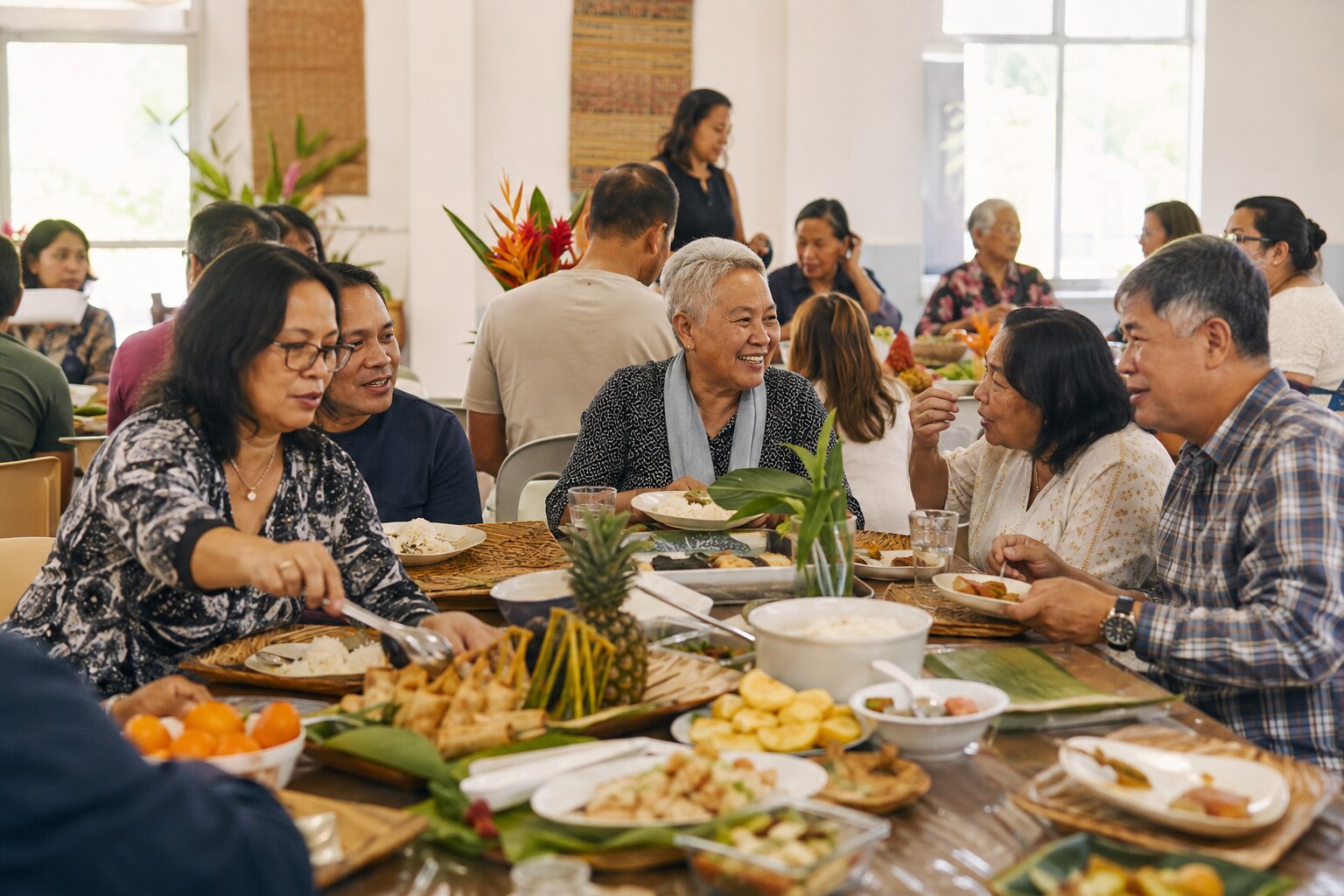
5. Why are food and hospitality closely connected?
Offering food is a familiar way of welcoming guests in many Filipino homes and gatherings. A visitor may hear an invitation to eat even when the household was not expecting company. Shared meals create space for conversation and reinforce relationships. This does not mean every offer is governed by one hidden rule; it means food often carries social meaning beyond basic nourishment.
Philippine diplomatic events describing kamayan connect communal dining with togetherness, unity and camaraderie. At fiestas, birthdays, family reunions and ordinary visits, the table can become the centre of the gathering. Guests should accept or decline politely, compliment the cook sincerely and avoid wasting food. If you have allergies or dietary restrictions, say so clearly rather than silently risking a reaction. Hosts generally prefer honest information that allows them to care for guests properly.
6. What is a fiesta?
A fiesta is a community celebration, often associated with a patron saint in predominantly Christian areas, although festival traditions across the Philippines are diverse. Programmes may include religious observances, processions, music, dance, competitions, markets, shared food and family homecomings. The scale ranges from local barangay celebrations to events known nationally and internationally.
It is a mistake to treat all fiestas as colourful street parties detached from faith, history or community responsibility. Some celebrations are primarily religious; others emphasise harvest, local products, historical events or Indigenous traditions. Tourism pages may promote spectacular performances, but residents also experience preparation costs, volunteer work, traffic and family obligations. If visiting, follow local rules, ask before photographing worship and distinguish staged festival performance from private or sacred practice.
7. What is bayanihan?
Bayanihan is commonly explained as a spirit of communal cooperation and helping one another. Popular imagery shows neighbours carrying a traditional house together, but contemporary use is broader: communities may organise support after disasters, help with local projects or contribute to a family in need. Philippine representatives also use the term when discussing solidarity among Filipinos overseas.
Like any cultural value, bayanihan should not be romanticised into a claim that conflict or inequality does not exist. Communities are complex, and cooperation depends on trust, resources and circumstance. Australians can understand the idea through practical mutual aid while respecting its Filipino context. The best way to recognise bayanihan is not to use the word as a marketing slogan; it is to notice or participate in genuine collective effort when invited.
8. Is the Philippines mainly Catholic?
Roman Catholicism is the largest reported religious affiliation. In the Philippine Statistics Authority’s 2020 census, 78.8 per cent of the household population identified as Roman Catholic. Islam was the next largest reported affiliation at 6.4 per cent, followed by Iglesia ni Cristo and other faiths. These figures show why Catholic festivals and practices are publicly visible, but they also show that the country is religiously diverse.
Islam has a long and important history in the southern Philippines, particularly in Mindanao and the Sulu archipelago. Indigenous belief systems, Protestant and evangelical churches, independent Christian traditions and other religions are also part of national life. Do not assume a Filipino person’s beliefs from their name, appearance or home region. If catering for a group, ask directly about halal requirements, fasting, alcohol and other dietary needs.
9. What cultural traditions are internationally recognised?
UNESCO has inscribed several Philippine traditions on its Intangible Cultural Heritage lists and registers. The Hudhud consists of narrative chants of the Ifugao traditionally performed in connection with rice sowing, harvest and funeral wakes and rituals. The Darangen is an epic tradition of the Maranao people. Aklan’s piña handloom weaving involves knowledge associated with producing fine textile from pineapple leaf fibre. The School of Living Traditions programme supports community-based transmission of cultural knowledge.
Recognition does not turn these traditions into public property that anyone can reproduce without context. Safeguarding centres the communities who practise and transmit them. Australians learning about these traditions should use UNESCO and Philippine cultural institutions as starting points, then seek community voices. Purchase genuine craft responsibly, credit makers and avoid copying sacred or community-specific designs merely because they look attractive.
10. What role does food play in cultural identity?
Food carries memory of place, family and migration. Regional ingredients and techniques tell stories about agriculture, trade and adaptation. The Philippine government observes Filipino Food Month every April to conserve, promote and popularise culinary heritage. Its programmes emphasise local produce, farmers, fisherfolk, cooks and the diversity of traditions across Luzon, Visayas and Mindanao.
For Filipinos in Australia, cooking can maintain connection across distance while also adapting to local ingredients and mixed households. An Australian-grown vegetable may replace something difficult to source; a recipe may be adjusted for a workplace or intergenerational family. Adaptation does not automatically erase authenticity, but accurate naming and acknowledgement matter. Ask who taught the recipe, where it comes from and how it has changed. Those questions reveal more than ranking whether one restaurant tastes ‘most authentic’.
11. How should Australians ask cultural questions?
Begin with the understanding that one person cannot represent more than one hundred million people and every regional community. Ask about personal experience: ‘What language did your family speak at home?’ or ‘Which dishes do you associate with celebrations?’ Avoid questions that presume poverty, political views, religion or migration history. Do not use a colleague as an unpaid cultural consultant during every workplace discussion.
Names deserve care. Filipino naming patterns are diverse, and pronunciation matters. If you make a mistake, correct it without turning the apology into a performance. Learn the difference between Filipino, which can refer to the national language and people, and Tagalog, a language with its own regional and historical basis. Use the terms individuals choose for themselves rather than enforcing terminology from overseas debates.
12. Where can Australians learn more?
Use primary and community-connected sources. The Philippine Statistics Authority provides census information about languages and religion. UNESCO documents recognised living heritage and safeguarding work. The National Commission for Culture and the Arts, National Museum of the Philippines, Philippine embassies and official tourism bodies provide further context. Sources should be compared, especially when a simple tourism description risks hiding regional complexity.
Local experience matters too. Attend public Filipino community events, support Filipino-owned businesses and listen to the stories attached to food, music and craft. In Bunbury, Hernandez Asian Delights offers an everyday point of connection through groceries, meals and catering. A respectful cultural education is not completed by reading one article. It grows through reliable information, real relationships and a willingness to recognise both shared identity and difference.
A final note about respectful curiosity
Cultural learning works best when facts and relationships reinforce each other. Statistics explain linguistic and religious diversity, while conversations reveal how individuals experience that diversity. Heritage listings document important practices, but community members explain what safeguarding means in daily life. Food introduces flavour and memory, but it should not become the only lens through which Filipino people are understood.
For Australian readers, the practical standard is simple: verify claims, name regions accurately, avoid stereotypes and allow people to describe their own identity. Curiosity is valuable when it is paired with humility. The Philippines is not one story waiting for a quick summary; it is a nation of many communities, histories and living traditions that deserve sustained attention.
Keep exploring Filipino food and culture
Taste it in Bunbury
Bring Filipino flavour to your next gathering.
Explore catering from Hernandez Asian Delights or visit Michael and the team at 36 Charles Street, Bunbury.